ERCES Challenges: Solving Coverage Gaps in Modern Buildings
Why Modern Buildings Create ERCES Challenges
Modern architecture is designed for sustainability, energy efficiency, and aesthetics. Unfortunately, those same design choices often create in-building radio dead zones that put first responder communication at risk.
Emergency Responder Communication Enhancement Systems (ERCES) are the solution, extending public safety radio coverage into areas where signals cannot penetrate. But even with ERCES, building materials, layouts, and occupancy types pose significant challenges.
At PMC Wireless, we specialize in solving these coverage gaps with first responder radio coverage solutions that are compliant, reliable, and tailored to each building type.
In this post, we’ll examine:
- Building materials that block signals
- Problem areas like stairwells and basements
- How building type impacts ERCES design
- A real-world case study of ERCES solving dead zones
Materials That Block Radio Signals
The single biggest challenge to ERCES performance comes from the very materials that make modern buildings strong and efficient.
Concrete
- Thick reinforced concrete dramatically weakens radio signals.
- Underground parking garages, basements, and mechanical rooms are especially vulnerable.
Metal
- Steel framing, beams, and roofing reflect and absorb radio frequencies.
- Metalized coatings and roofing materials cause unpredictable signal behavior.
Low-E Glass
- Energy-efficient low-emissivity glass is coated with metallic films to block heat transfer.
- These coatings also block radio frequency signals, creating dead zones even in rooms with full window walls.
Composite & Sustainable Materials
- New green construction materials often include layers of foil, mesh, or insulation that block signals.
- LEED-certified buildings may score high on efficiency, but without ERCES, they fail on radio coverage.
Takeaway: The more energy efficient and reinforced a building is, the more likely it is to require ERCES to eliminate coverage gaps.
Special Problem Areas in Modern Buildings
Even within a single building, certain spaces are notorious for creating in-building radio dead zones.
Stairwells
- Enclosed stairwells are usually surrounded by thick concrete walls.
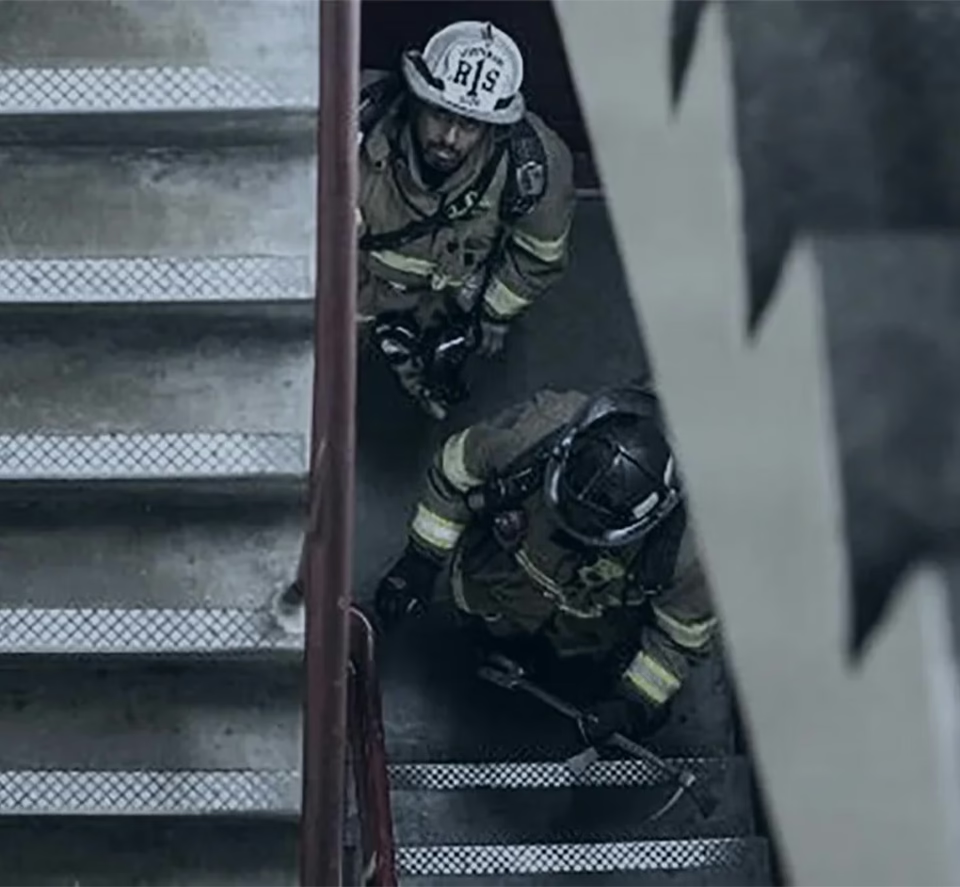
- These vertical escape routes are critical for evacuations but often block radio communication entirely.
Basements
- Subgrade levels are shielded by concrete and rebar.
- Mechanical and utility rooms in basements are usually inaccessible to natural signals.
Elevator Shafts
- Elevators act as RF traps, combining steel enclosures and vertical shafts that block or distort signals.
- ERCES coverage is critical since first responders often need elevator access during emergencies.
Mechanical & Utility Rooms
- Pump rooms, HVAC units, and generator spaces are often surrounded by reinforced walls.
- These areas house critical systems, yet radios frequently fail inside them.
Parking Garages
- Concrete ceilings, ramps, and rebar create extremely challenging environments for public safety coverage.
- Garages are often excluded from cellular DAS, but must be included in ERCES design.
PMC Wireless conducts grid testing to identify and eliminate these specific dead zones before final ERCES commissioning.
Designing ERCES for Different Building Types
Not all buildings are created equal. ERCES design must adapt to building use, layout, and occupancy type.
High-Rises
- Challenges: Multiple floors, dense concrete, steel framing, stairwells, elevator shafts.
- Solution: Engineered Public Safety DAS with distributed antennas on each floor, high-isolation donor antennas, Class A BDAs.
- Key Focus: Vertical coverage for stairwells and elevator shafts.
Warehouses & Distribution Centers
- Challenges: Large open spaces, high ceilings, metal shelving, minimal walls.
- Solution: Wide-coverage antennas with selective placement near critical areas.
- Key Focus: Even coverage without interference.
Hospitals & Healthcare Facilities
- Challenges: Complex layouts, reinforced imaging rooms, underground labs, critical zones.
- Solution: Layered ERCES design with dedicated antennas, redundant BDAs, enhanced monitoring.
- Key Focus: Reliability and redundancy.
Schools & Campuses
- Challenges: Sprawling footprints, gymnasiums, auditoriums, basements.
- Solution: Sectorized DAS design and planning for large gathering areas.
- Key Focus: Student safety and large-area coverage.
PMC Wireless tailors first responder radio coverage solutions to each building type, ensuring compliance and performance.
Case Study: Solving Coverage Gaps in a High-Rise
Challenge
A newly constructed 30-story mixed-use high-rise in New Jersey failed its initial AHJ radio coverage test. LEED-certified design and Low-E glass contributed to dead zones in stairwells, basements, and elevators.
Solution
- A rooftop donor antenna aligned to the local public safety tower.
- A Class A BDA tuned for multiple public safety frequency bands.
- A Public Safety DAS with antennas in stairwells, elevator lobbies, and underground parking.
- Fire-rated coaxial cabling with splitters and filters.
- Battery backup with 24-hour runtime and fire alarm integration.
Results
- The building passed its AHJ inspection on the first retest.
- Grid testing confirmed 99% coverage in critical areas and 95% throughout.
- The property secured its Certificate of Occupancy on schedule.
This case underscores the importance of professional ERCES design and installation, especially in modern buildings with challenging materials.
Why Professional Expertise Is Critical
- Every building uses different materials that affect RF propagation.
- Layouts create unique dead zones requiring tailored DAS design.
- Local AHJs may have specific coverage and documentation requirements.
- Poorly designed systems risk interference, oscillation, or inspection failure.
PMC Wireless delivers ERCES systems that eliminate coverage gaps and keep first responders connected.
PMC Wireless: Solving ERCES Coverage Gaps
Our Process
- RF Surveys & Coverage Testing
- Custom ERCES Design
- Public Safety BDA Installation
- DAS Deployment
- Battery Backup & Monitoring
- AHJ Coordination & Documentation
- Maintenance & Annual Testing
With PMC Wireless, building owners avoid delays, failed inspections, and liability risks while ensuring reliable first responder communication.
Conclusion: Solving ERCES Challenges Protects Lives
Modern buildings create ERCES coverage gaps that put first responders at risk, but with the right partner, these challenges can be overcome. PMC Wireless provides the expertise and solutions needed to deliver compliant, reliable, life-saving in-building coverage.
Contact PMC Wireless today to schedule an ERCES coverage assessment.